Private label
Private Label Matcha Powder Sourcing
InMatcha supports brands that need grade selection, sample testing, packaging direction, and documentation discussion before launching retail or foodservice products.
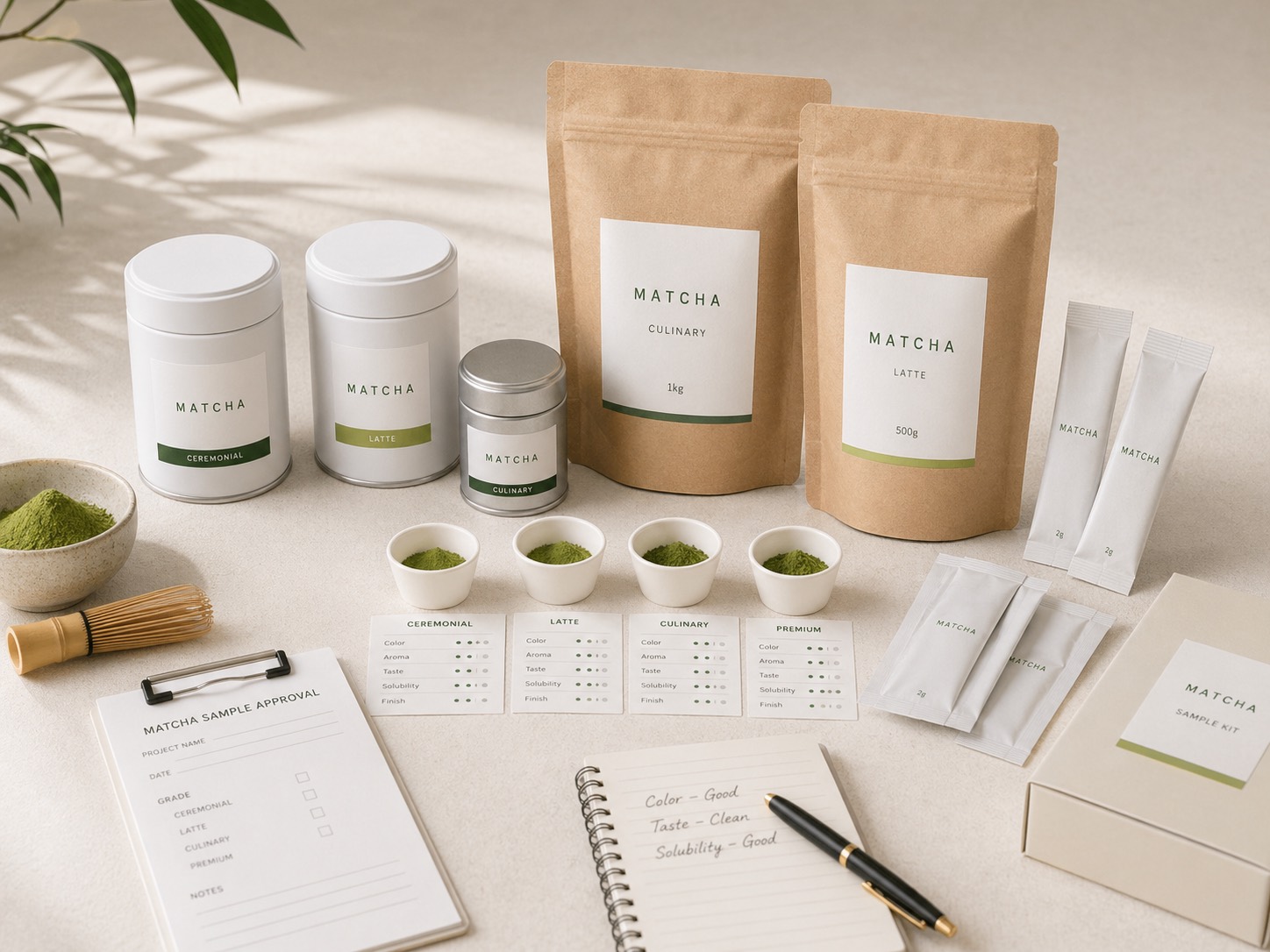
InMatcha supports this page as a buyer decision path. Buyers should confirm application, target market, estimated volume, packaging direction, cost target, and documentation requirements before sample dispatch. Industrial 1A remains a cost-controlled industrial and application grade; it is not positioned as the main premium cafe or latte-grade route.
Buyer questions
Real questions private-label buyers should answer
| Question from real use | Buyer risk | How to test or answer it |
|---|---|---|
| How should the product be positioned? | Wrong grade positioning can create poor consumer expectations | Map the product to everyday latte, premium retail, culinary, wellness, foodservice, or documented route. |
| How green should the powder look? | Retail buyers may judge quality visually before tasting | Compare dry powder color, brewed color, storage needs, packaging protection, and market expectation. |
| How much bitterness is acceptable? | Consumer tolerance varies by recipe, market, and use case | Test plain taste, latte taste, sweetened use, and target-market expectations before label positioning. |
| What claims can the brand safely make? | Overclaims can create compliance and trust risk | Tie origin, organic, residue, certification, and documentation language to selected supplier path and confirmed documents. |
Buyer decision table
What to test before commercial planning
| Buyer need | Likely direction | What to test |
|---|---|---|
| Retail pouch or tin | Premium Retail Grade | Visual quality, positioning, packaging presentation |
| Foodservice bag | Cafe / Latte, Beverage, or Culinary Grade | Application fit, cost target, repeat use |
| Wellness or organic route | Documented supplier path | Valid records, market relevance, batch confirmation |
| Launch sample kit | Comparison samples | Grade, packaging, and documentation fit |
Sample-first workflow
A focused sample test should answer performance, cost, packaging, and documentation questions before larger order discussion.
- Share the application and target market.
- Confirm grade direction and sample route.
- Test in the real recipe, menu item, or product workflow.
- Review packaging, MOQ, and documentation needs.
- Use feedback to decide the next commercial step.
Timeline
From sample to shelf: a realistic timeline
| Stage | Typical duration | What happens |
|---|---|---|
| 1. Grade & sample fit | Weeks 1–2 | Application-matched samples tested against your target profile and price point |
| 2. Packaging & label files | Weeks 3–4 | Format selection, dielines, artwork, market labeling review (US/EU) |
| 3. Pilot approval | Weeks 5–6 | Filled pilot units approved for color, fill, seal, and label accuracy |
| 4. Production & QC | Weeks 7–10 | Production run, batch COA, market testing (EU MRL where relevant) |
| 5. Freight & launch | Weeks 10–14 | Ocean freight, customs clearance with the document stack, goods to your 3PL |
First runs take a quarter; repeat runs compress to weeks once specs, labels, and testing cadence are locked.
Formats
Packaging formats for private label
| Format | Typical use | Notes |
|---|---|---|
| Stand-up pouch (100 g / 250 g) | Retail & e-commerce | Resealable, lowest-cost retail format, fastest to launch |
| Tin (30 g / 100 g) | Premium retail, gifting | Higher unit cost, strong shelf presence |
| Foodservice bag (1 kg) | Cafes & foodservice under your brand | Workhorse format for B2B2B programs |
| Bulk (5–20 kg foil) | Local co-packing | Cheapest per kg; you control filling and labor locally |
Full options and custom specs: private label matcha packaging.
Compliance
Labels and market compliance, handled early
Label problems are launch killers because they surface last. Build the compliance file alongside the artwork, not after:
- US route: FDA-registered facility, US labeling conventions, responsible-party details on pack.
- EU route: batch-level pesticide MRL testing, EU operator address, language and FIC labeling requirements — the full checklist is in our EU matcha import compliance guide.
- Organic claims: certification routes must match the destination market (USDA vs EU organic are separate chains — raise it in the first conversation).
Costing
Cost your product backwards from the shelf
Start at shelf price and walk back: retail margin, channel costs, freight and duty, packaging, then powder. A $19.99 / 100 g pouch typically needs landed matcha in the $40–70/kg band to keep everyone’s margin healthy — a band that’s comfortably available in China-grown grades and mostly unreachable in Japanese equivalents at 2026 prices. Full market bands and the landed-cost stack: bulk matcha price guide.
FAQ
Private label questions
What is the MOQ for private label matcha?
Commercial discussions start at 20 kg of powder. Retail-format MOQs depend on packaging: factory-filled pouches and tins carry per-format minimums, while bulk bags for local co-packing start lower.
How long does a private label matcha launch take?
A realistic first run is 10–14 weeks: grade sampling, packaging and label files, pilot approval, production with batch documentation, and freight. Repeat runs compress significantly.
Can you support both US and EU compliance?
Yes — FDA-registered facility routes and labeling support for the US; pesticide MRL testing discussion, EU labeling requirements, and organic import routes for Europe.
Do I need my own packaging design?
You provide brand artwork; packaging dielines and format specs come from the supply side. Stock formats (stand-up pouches, tins, foodservice bags) keep first runs simple.
What margin can a private label matcha product make?
Work backwards from shelf price: a $19.99 / 100 g pouch typically needs landed powder cost around $40–70/kg for healthy margins after packaging, freight, duty, and channel costs.
Sample-first sourcing
Ready to test this sourcing path?
Share your application, market, estimated volume, packaging direction, and documentation needs so InMatcha can suggest a practical sample route.