Cafe / latte grade
Latte Grade Matcha for Cafes, Drinks, and Foodservice
Cafe and latte buyers should test matcha for green color, balanced bitterness, milk performance, hot and iced workflows, and cost per serving.
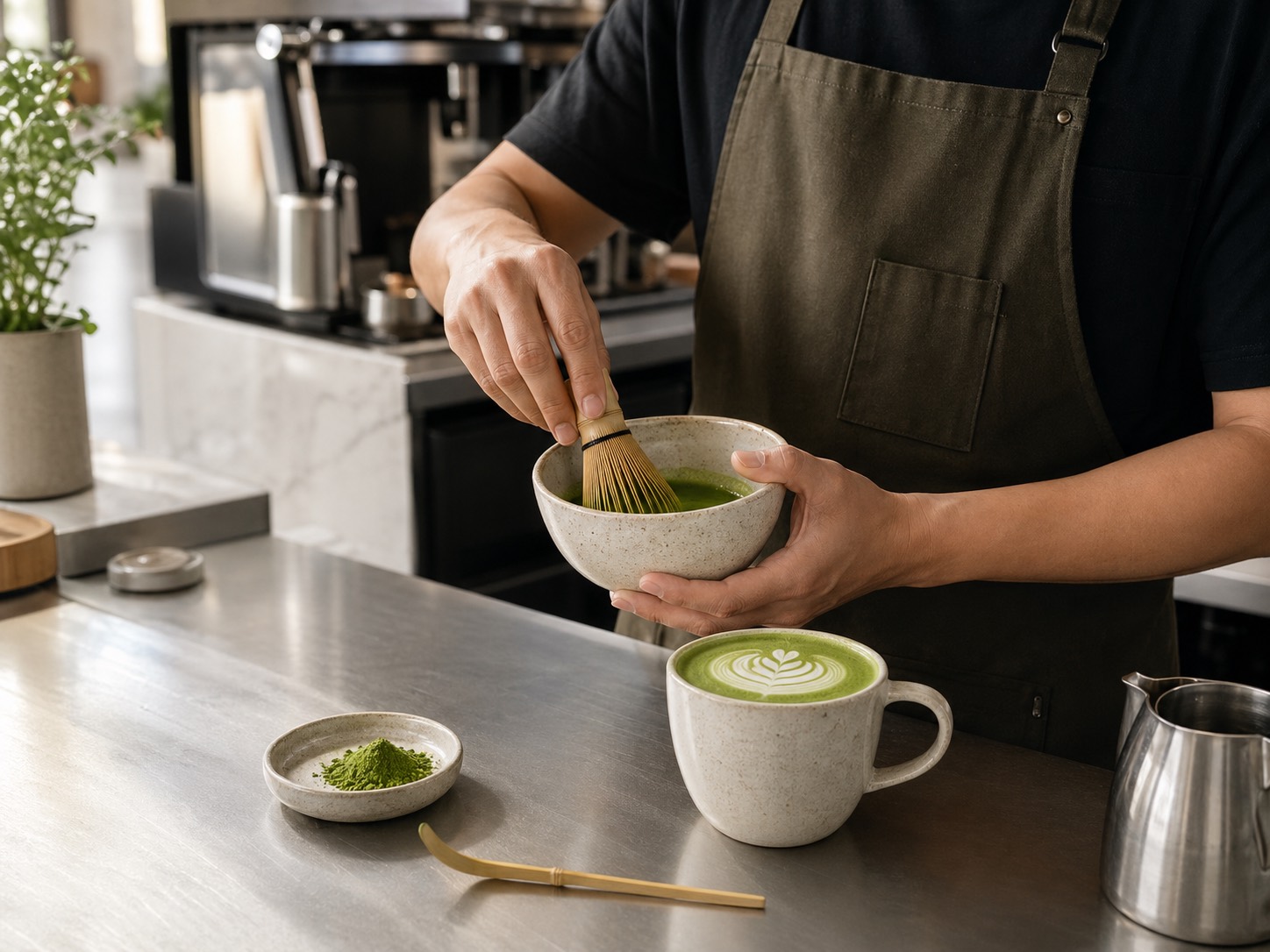
InMatcha supports this page as a buyer decision path. Buyers should confirm application, target market, estimated volume, packaging direction, cost target, and documentation requirements before sample dispatch. Industrial 1A remains a cost-controlled industrial and application grade; it is not positioned as the main premium cafe or latte-grade route.
Buyer questions
Real questions latte and cafe buyers should answer
| Question from real use | Buyer risk | How to test or answer it |
|---|---|---|
| Why is the latte too bitter? | A visually strong powder can still fail repeat drink orders | Record dosage, water temperature, milk ratio, sweetness, aftertaste, and customer tolerance. |
| Why does the latte look pale or yellowish? | Milk, ice, oxidation, and grade fit can reduce visible color | Compare dry color, hot latte color, iced latte color, plant milk behavior, and holding time. |
| Should cafes choose ceremonial, latte, or beverage grade? | Retail labels do not always match cafe workflow or margin | Test cafe / latte grade and balanced beverage grade in the exact menu recipes. |
| How should cafes control cost per serving? | Premium samples may work but miss menu margin | Calculate dosage, grade cost, cup size, waste, milk/sweetener use, and acceptable taste/color tradeoff. |
Buyer decision table
What to test before commercial planning
| Buyer need | Likely direction | What to test |
|---|---|---|
| Hot latte | Cafe / Latte Grade | Milk color, bitterness, mouthfeel |
| Iced latte | Cafe / Latte or Balanced Beverage Grade | Cold mixing, sediment, ice dilution |
| Plant milk drink | Cafe / Latte Grade | Plant milk compatibility, aftertaste |
| Cost-controlled menu | Balanced Beverage Grade | Acceptable color, taste, cost per serving |
Sample-first workflow
A focused sample test should answer performance, cost, packaging, and documentation questions before larger order discussion.
- Share the application and target market.
- Confirm grade direction and sample route.
- Test in the real recipe, menu item, or product workflow.
- Review packaging, MOQ, and documentation needs.
- Use feedback to decide the next commercial step.
Specification
What makes a matcha “latte grade”
Latte grade is a performance spec, not a quality tier. The drink is mostly milk — so the powder is judged on what survives milk:
| Attribute | What to look for |
|---|---|
| Dry color | Vibrant green with no yellow or olive cast — the ceiling for everything downstream |
| Color under milk | Stays visibly green against dairy and oat milk instead of fading to grey-beige |
| Fineness | Fine, even milling; smooth mouthfeel with no grit at the bottom of the cup |
| Bitterness at 2 g | Present but balanced at menu dosage — enough character to read as matcha, no harsh astringency |
| Suspension | Slow separation in iced drinks; re-integrates with a single stir |
Our latte line is China-grown, high-mountain, shade-cultivated leaf milled fine specifically for this spec — and priced so the math works per cup.
Dosing
Dosing guide by cup size
| Drink | Typical dose | Note |
|---|---|---|
| 8 oz hot latte | 1.5–2 g | Classic ratio; whisk or shake fully before milk |
| 12 oz hot latte | 2–2.5 g | The volume most menus standardize on |
| 12 oz iced latte | 2.5–3 g | Ice melt dilutes — dose up to hold flavor and color |
| 16 oz iced latte | 3–3.5 g | Test color over ice at 10 minutes, not at pour |
| 16 oz blended | 3–4 g | Blending aerates and mutes color; highest dose tier |
Dose discipline is margin discipline: at $60/kg, a 2 g serving costs $0.12; at 3.5 g it’s $0.21. Full cost-per-serving math by price tier: bulk matcha price guide.
Hot vs iced
Hot and iced lattes stress different things
- Hot: aroma and bitterness are amplified by heat — grade balance matters most here. Water temperature off the boil (75–85°C for the concentrate) keeps astringency in check.
- Iced: cold suppresses aroma, so color does the talking — a vivid green over white milk in a clear cup is the product photo customers buy. Check separation and color at 10 minutes, not at pour.
- Plant milks: oat and soy shift both color background and sweetness. Always test in the exact milks on your menu — a grade that wins in dairy can read differently under oat.
Testing
The 20-minute blind test before you switch
Run candidates against your current matcha, blind, in your real recipe: dry color → whisked color under your milk → color after 10 minutes on ice → bitterness at your dosage → cost per serving. Five checks settle what brand stories can’t. For the origin question specifically, see China-grown vs Japanese matcha for commercial use; to map grades first, start at the grade comparison.
FAQ
Latte grade questions
What is latte grade matcha?
A grade selected for milk drinks: vibrant color that holds under dairy and plant milks, fine smooth texture, and balanced bitterness at a 2 g working dose — at a cost per serving that works on a menu.
How much matcha goes in a latte?
Typical dosing: 1.5–2 g for an 8 oz hot latte, 2–2.5 g for 12 oz hot, 2.5–3 g for 12 oz iced, and 3–3.5 g for 16 oz iced — iced drinks need more because melting ice dilutes the cup.
What is the difference between latte grade and ceremonial matcha?
Ceremonial grades are optimized for drinking straight, where delicate top notes matter. Latte grades are optimized for performance under milk — color, body, and bitterness balance — because milk masks the subtleties you’d pay a premium for.
Does latte grade matcha work for iced drinks?
Yes — but test it iced specifically: check color after 10 minutes over ice, separation behavior, and flavor at the higher iced dose before committing.
How should cafes test latte grade samples?
Blind, in your real recipe: dry color, whisked color under your actual milk, color after 10 minutes on ice, bitterness at your dosage, and cost per serving at your volumes.
Sample-first sourcing
Ready to test this sourcing path?
Share your application, market, estimated volume, packaging direction, and documentation needs so InMatcha can suggest a practical sample route.